
News
MSU scientist earns national honor for transforming the future of agriculture
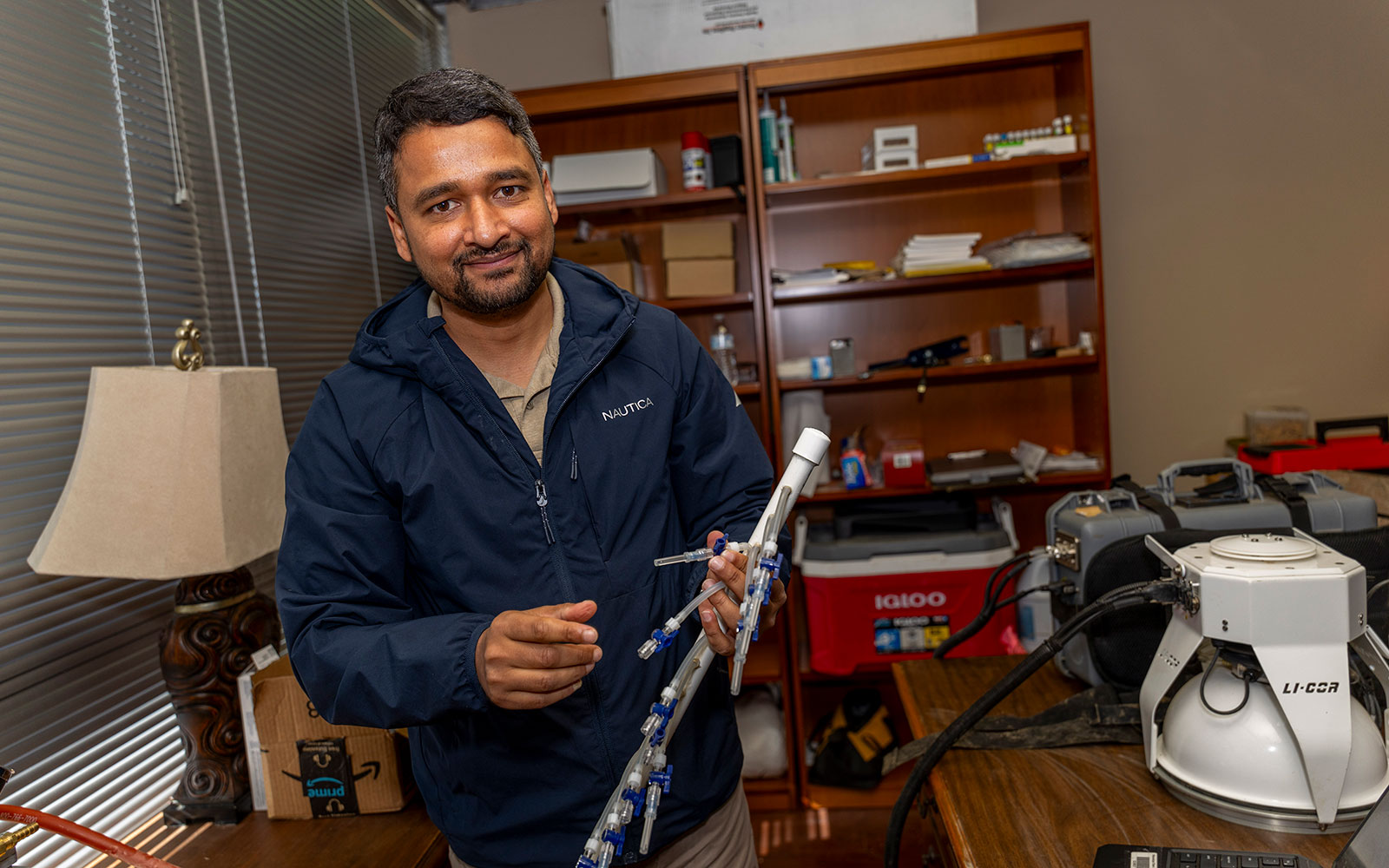
From healthier soils to cleaner rivers, the impact of Madhav Dhakal's research is reshaping agriculture across the country—and the nation is taking notice. The Mississippi State University assistant research professor received the 2025 Conservation Research Award from the Soil and Water Conservation Society, one of the field's most respected national honors.
The award recognizes Dhakal as a leading conservation innovator whose breakthrough research addresses some of the most pressing challenges in soil and water sustainability. It also highlights the pivotal role of MSU's Water Resources Research Institute in advancing practical, science-driven solutions for modern agriculture.
"Being recognized by such a respected scientific society shows that the work we're doing isn’t just theoretical—it's producing measurable results in real-world systems," Dhakal said. "It brings national visibility to our institute and highlights how our entire team is advancing conservation at scale."
Supported by the USDA Agricultural Research Service, Dhakal's research centers on regenerative agriculture—an approach designed to restore soil health, protect water resources and reduce the long-term environmental costs associated with conventional farming.
Traditional practices such as intensive tillage or leaving fields bare in winter can lead to erosion, nutrient runoff and declining soil fertility. Dhakal's work demonstrates how regenerative strategies—including cover crops, reduced tillage and improved field management—strengthen soils' ability to retain water and nutrients, creating more resilient and productive crop systems.
His findings emphasize that conservation and profitability can move forward together. Cover crops help filter pollutants before they reach nearby rivers and streams, while reduced tillage improves drought tolerance, protects long-term soil structure and can support stronger yields.
Dhakal's earlier studies have also shown how these practices shrink agriculture's overall water footprint without sacrificing crop quality.
With this national honor, Dhakal's work underscores how innovation in the field can create ripple effects far beyond the farm—strengthening rural economies, protecting natural resources and shaping a more sustainable agricultural landscape one healthy acre, one cleaner stream and one farming community at a time.
"Dr. Dhakal's research exemplifies the mission of the Water Resources Research Institute—delivering practical, science-based solutions that benefit Mississippi, the region and the nation," said Jason Barrett, associate Extension professor and director of WRRI. "His work is helping chart a future where agricultural innovation and environmental stewardship move forward together."
View More News